Mom was awake when I got home.
She was sitting in her armchair, looking toward the window.
The train ticket and luggage tag were still beside her.
She turned when she heard me enter.
“Where have you been, sweetheart?”
I held up the camera.
Her expression changed.
She looked at it for several seconds.
Then she looked at me.
“You opened the suitcase.”
It wasn't a question.
“Yes.”
She lowered her eyes.
I sat opposite her.
“I went to see Margaret.”
Mom looked startled.
For a moment, neither of us spoke.
Then she asked the question that told me everything about what mattered most to her.
“Is she all right?”
I nodded.
“She was worried about you.”
Mom seemed relieved.
“She's had such a difficult time.”
“I know.”
Her eyes moved toward the camera again.
“She didn't want anybody knowing.”
I put it down beside the train ticket.
“Mom, I'm not anybody.”
She looked at me.
I could see that she was trying to decide what to say.
“I promised her.”
“I understand that.”
And I did.
I understood why an elderly woman who had lost her home might want to keep that information private.
I understood why my mother wanted to honor a promise made to someone she had known since childhood.
But I couldn't accept the price she had paid.
“You frightened me.”
Her face softened.
“Oh, honey.”
“No, Mom. You really frightened me.”
My voice broke.
I hadn't intended for that to happen.
I had spent the entire drive home thinking about what I would say.
I wanted to remain calm.
I wanted to explain myself without making her feel guilty.
But looking at her sitting there in clothing that no longer fit properly, I couldn't hold everything inside.
“You came home looking like you hadn't eaten in a week.”
She tried to smile.
“I'll be better after a little rest.”
It was almost exactly the sort of answer she had given me at the station.
This time, I wasn't willing to accept it.
“We're going to get you examined.”
She shook her head.
“There's no need.”
“There is.”
She looked away.
I moved closer.
“Margaret told me everything.”
Mom rubbed her hands together.
I watched her fingers move slowly.
She finally admitted that she had become ill several days into the trip.
At first, she thought it was something she had eaten.
Then she began feeling weak.
She hadn't been able to eat much, and drinking enough had become difficult.
But Margaret needed her.
There were arrangements to make.
There were belongings to pack.
There was nowhere safe for Margaret to stay unless somebody helped her.
My mother had decided that somebody would be her.
“I couldn't leave her like that.”
“I wouldn't have asked you to.”
She looked surprised.
“I could have helped, Mom.”
She said nothing.
“I could have driven there. I could have carried the bags. I could have made telephone calls.”
Her eyes began to fill.
“You have your own life.”
That sentence hurt more than I expected.
My mother had apparently reached the conclusion that asking me for help meant interfering with my life.
I wondered how long she had felt that way.
I wondered how many other difficulties she had quietly handled because she didn't want to inconvenience me.
“Mom, you're part of my life.”
She wiped her cheek.
I took her hand.
It felt smaller than I remembered.
“You don't have to wait until something terrible happens before you call me.”
She nodded.
But I could tell that accepting those words wasn't easy for her.
She had spent decades being the person other people relied on.
Receiving help felt unfamiliar.
Perhaps even embarrassing.
I understood that better after meeting Margaret.
Both women had been reluctant to admit they couldn't manage everything alone.
One had lost her home.
The other had almost lost her strength trying to help her.
Neither had wanted to become a burden.
I stood and reached for my car keys again.
“Come on.”
Mom looked toward the hallway.
“What about the suitcase?”
“It can wait.”
“Margaret needs those things.”
“I'll take care of them.”
She hesitated.
I held out my hand.
After a moment, she accepted it.
We went to the hospital.
The examination confirmed that her condition needed attention.
She was dehydrated, exhausted, and had experienced substantial weight loss during the trip.
The medical staff explained that some of the apparent change in her size was likely related to fluid loss.
They took her symptoms seriously, especially because of her age.
She needed fluids, further assessment, proper nutrition, and rest.
For once, my mother didn't argue.
She looked tired enough to accept that she needed someone else to take responsibility.
I sat beside her while she received treatment.
Occasionally, she asked about Margaret.
I reassured her.
The temporary residence was safe.
Margaret had a room.
Her belongings could be returned.
Nothing required Mom to get out of bed and solve another problem.
“You're allowed to rest now,” I told her.
She gave me a faint smile.
“I suppose I am.”
Those were the first words she had spoken that made me feel genuinely relieved.
After the medical staff were satisfied that she was stable, we returned home with instructions for her recovery and follow-up care.
I helped her settle into her armchair.
Then I went to her bedroom.
The black suitcase was where I had left it.
I opened it again, this time with her permission.
We sorted through the clothing.
She showed me which items belonged to Margaret and which ones were hers.
The brown envelope remained sealed.
I didn't need to open it.
Margaret had already explained its contents, and those documents were her private business.
I placed everything together carefully.
The old digital camera still had almost no battery power.
Mom told me that Margaret had wanted photographs because she was afraid of forgetting the difficult journey that had brought her somewhere safe.
Not because the journey had been pleasant.
Because it represented a new beginning.
My mother smiled when she told me that.
“She's always liked keeping pictures.”
I looked at the camera.
Something I had treated as evidence of a possible disaster was really a record of two friends helping each other through a difficult week.
The photographs hadn't lied.
I had simply misunderstood their meaning.
The following day, I returned to Margaret's residence.
I brought the clean clothes, the sealed brown envelope, the luggage tag, and the camera.
Margaret was sitting in the same chair when I arrived.
She looked anxious.
“How's your mother?”
“She's getting better.”
Margaret closed her eyes briefly.
“Thank goodness.”
I handed her the envelope first.
She placed it carefully beside her.
Then I gave her the camera.
“I think you'll need to charge this.”
She laughed softly.
It was the first time I had heard her laugh.
I could understand why my mother had wanted to see her again after so many years.
Beneath the exhaustion and worry, there was a warmth about her.
The sort of warmth my mother had always valued in people.
Margaret thanked me for returning her belongings.
Then she asked about the suitcase.
I explained that Mom wanted her to keep it.
Margaret shook her head.
“She can have it.”
I smiled.
“I think we're both going to argue about that for a while.”
She laughed again.
Before leaving, I asked whether there was anything else she needed.
For a moment, she gave the answer I had expected.
“No, dear.”
Then she stopped.
“Well, actually…”
She asked whether I could help her arrange another visit with my mother once Mom was strong enough.
“Of course.”
Her expression brightened.
I left knowing that I would be back.
My mother hadn't been wrong to help Margaret.
She had been wrong to believe that helping required her to do everything alone.
Over the following weeks, Mom gradually regained her strength.
Her appetite returned.
The clothing that had hung so loosely around her shoulders began fitting better.
She followed her medical instructions, attended her appointments, and allowed me to help with things she would normally have insisted on doing herself.
It wasn't always easy.
Sometimes I caught her trying to accomplish too much.
Sometimes she would tell me she didn't need assistance when she clearly did.
But we talked about it.
I stopped assuming that her cheerful smile meant everything was fine.
She stopped assuming that asking for help would inconvenience me.
We were both learning.
One afternoon, I drove her to visit Margaret.
I carried the black suitcase into the building.
Mom had insisted on returning it in person.
Inside were a few things Margaret needed, along with something Mom had baked after she was well enough to return to the kitchen.
When Margaret saw us, her whole face brightened.
The two women embraced carefully.
Neither of them was particularly strong.
But they held each other for a long time.
I stood nearby with the suitcase.
For the first time, it didn't frighten me.
It wasn't a mysterious object connected to missing days.
It was simply an old suitcase that had carried the belongings of a woman who needed somewhere safe to live.
And it had carried my mother's promise to protect her friend.
Margaret finally pulled away.
“You look much better.”
Mom smiled.
“I've been told I'm not allowed to do anything foolish.”
Margaret looked at me.
“Good.”
We all laughed.
There were no accusations.
No more secrets about the journey.
No need for my mother to pretend she was stronger than she was.
A few Sundays later, Margaret joined us for dinner.
I watched Mom move around the kitchen, taking her time.
Whenever she needed something, she asked.
I helped carry the dishes.
Margaret sat nearby, talking about the years when she and Mom were children.
They told stories I had never heard before.
They laughed over memories that belonged to a different lifetime.
Twenty years apart hadn't erased their friendship.
Neither had the difficult circumstances that brought them together again.
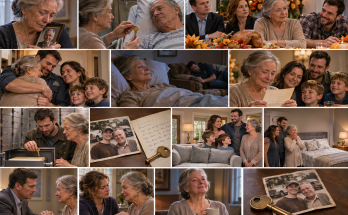
After dinner, Margaret brought out her digital camera.
The battery was fully charged.
She showed us the four photographs from their journey.
This time, my mother explained each one herself.
There was nothing to hide.
When we reached the final photograph, I looked closely at the two women standing outside the residence.
I remembered how frightened I had been when I first saw it.
Now I saw something different.
I saw my mother's determination.
I saw Margaret's exhaustion.
And I saw two people who had needed more help than either had been willing to admit.
Margaret raised the camera.
“Let's take another one.”
We moved closer together.
Mom sat beside her.
I stood behind their chairs.
Margaret took the photograph.
Five pictures now.
The newest one showed my mother smiling, her face healthier, her shoulders no longer disappearing inside loose clothing.
Margaret was smiling too.
There was food on the table.
There were familiar voices in the room.
And nobody was trying to carry a burden alone.
Later that evening, after Margaret had gone home, Mom and I sat together.
She looked at me quietly.
“I'm sorry I worried you.”
I took her hand.
“Just promise me something.”
“What?”
“Next time you need help, call me.”
She squeezed my fingers.
“I promise.”
I believed her.
Not because I thought she would never make another mistake.
But because we had finally spoken honestly about something that had been left unsaid for too long.
I hadn't wanted my mother to stop being generous.
I hadn't wanted her to give up her independence.
I only wanted her to understand that the kindness she offered everybody else was something she deserved to receive herself.
She was eighty years old.
She was still my mother.
Still cheerful.
Still determined.
Still capable of caring deeply about the people she loved.
But she didn't have to prove any of those things by exhausting herself.
The little blue travel bag was gone.
The black suitcase was back with Margaret.
The brown envelope was where it belonged.
The old camera contained a new photograph.
And my mother had returned to her Sunday dinners.
Sometimes, when I watched her sitting at the table beside Margaret, I thought about those seven days.
I remembered the fear I had felt at the station.
I remembered the sound of the telephone ringing.
I remembered the unfamiliar name on the luggage tag and the nearly exhausted camera battery.
Those ordinary objects had led me to an extraordinary truth about the woman I thought I knew completely.
My mother had spent a lifetime looking after other people.
It had taken one frightening week for both of us to understand that she deserved to be looked after, too.
From then on, whenever she needed something, she called.
And whenever the telephone rang, I was grateful she had.
The End
Read more original stories on Feel Every Story.
I Thought a Week Away Would Make My Eighty Year Old Mother Happy, but I Had No Idea What She Would Bring Home
Part 10 of 10