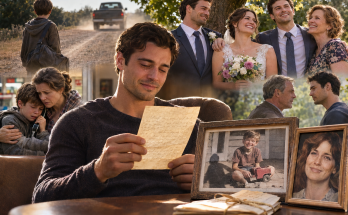
Natalie stopped when she saw me.
For a moment, neither of us spoke.
Her eyes moved toward the envelope in my hands.
Then she looked at my face.
“Stefan?”
I opened my mouth, but nothing came out.
She stepped forward and wrapped her arms around me.
That was when I stopped trying to hold myself together.
I cried against her shoulder.
She held me without asking me to explain anything.
When we finally separated, she wiped her face with the sleeve of her coat.
“The girls?”
“They're alive.”
“All four?”
I nodded.
She closed her eyes.
“Thank God.”
We stood in the hallway for another minute.
Then I brought her into the room where I had spent so much time reading Grace's letter.
Natalie noticed the empty chair beside mine.
She sat down slowly.
I placed the envelope on the table between us.
“Did you know?”
She looked at me.
“Know what?”
“About her heart.”
Her expression changed.
I watched her carefully.
There was no point pretending that the question wasn't important.
“She mentioned some trouble breathing,” Natalie said.
“When?”
“A while ago. She said the doctors were checking it.”
“Did she tell you how serious it was?”
Natalie shook her head.
“No.”
I reached into the envelope and removed the letter.
“She knew for eleven weeks.”
Natalie stared at me.
“What?”
“Eleven weeks, Natalie.”
I handed her the pages.
She began reading.
I watched her eyes move across the handwriting.
Several times, she stopped and went back over a sentence.
Her breathing became uneven.
Eventually, she lowered the letter.
“She never told me this.”
I looked at the floor.
“She didn't tell me either.”
Natalie covered her mouth.
For a while, the only sound in the room was the ventilation system.
I had started to hate that sound.
It reminded me of the hours I had spent discovering everything Grace had kept from me.
Natalie read the remaining pages.
When she finished, she folded them carefully.
“Why didn't she call me?”
I didn't have an answer.
She looked toward the window.
“I could have gone with her.”
Her voice broke.
“I could have stayed with her.”
I understood exactly what she was doing.
She was traveling backward through the same eleven weeks that had occupied my thoughts.
Searching for a moment when she could have changed something.
Searching for a mistake she could blame herself for.
I had already spent hours doing it.
“It wouldn't have been your decision,” I said.
Natalie looked at me.
“What?”
“She was determined not to worry us.”
Natalie shook her head.
“That doesn't make it right.”
“No.”
It was the first time somebody had said that directly.
Grace's decision had come from love.
But it had also left two people who loved her wondering why she hadn't allowed them to help.
I didn't know how to reconcile those things.
Apparently, neither did Natalie.
I showed her Grace's phone.
“There are recordings.”
Natalie hesitated.
“Can I hear them?”
I opened the video in which Grace spoke to the babies.
Her sister smiled almost immediately.
Then she began crying.
When Grace laughed at the end, Natalie pressed her fingers against her lips.
“That's her.”
I nodded.
We listened again.
For those few moments, we weren't talking about diagnoses or decisions.
We were listening to somebody we loved.
Somebody who had been excited about becoming a mother.
Natalie handed the phone back to me.
“Please keep those.”
“I will.”
“The girls need to hear them someday.”
“I know.”
She looked toward the door.
“Can I meet them?”
We went to the neonatal unit together.
Natalie followed the same precautions I had learned the previous day.
She washed her hands and put on the protective gown.
Then she stepped through the doors.
I watched her discover the four beds.
“Oh, Grace.”
She said her sister's name so quietly that I almost missed it.
I introduced her to Baby A.
Then Baby B.
Then Baby C.
Finally, Baby D.
Natalie stood beside each bed for several minutes.
She studied their faces.
“They're beautiful.”
I nodded.
She glanced at me.
“Have you decided on their names?”
“Not yet.”
The question made me uncomfortable.
Grace and I had talked about names.
But I couldn't bring myself to finish that conversation without her.
Natalie didn't pressure me.
She simply returned her attention to the babies.
Baby A moved her hand.
Natalie smiled.
“Look at those fingers.”
I leaned closer.
For a moment, I understood how much Grace would have enjoyed watching her sister meet our daughters.
Then the familiar pain returned.
I stepped backward.
Natalie noticed.
“Are you okay?”
I almost said yes.
The answer was already forming in my mouth.
Then I remembered Grace's letter.
“No.”
Natalie reached for my arm.
“Neither am I.”
We stood together beside the four little beds.
Neither of us tried to convince the other that everything would be fine.
Later, when we returned to the room, Natalie asked whether I had eaten.
I couldn't remember.
She looked at me with concern.
“You need something.”
“I'm not hungry.”
“I know.”
She went to find food anyway.
When she returned, she placed it in front of me.
I managed a few bites.
It was the first time since Grace's death that somebody had insisted on taking care of me.
I hadn't realized how much I needed it.
Natalie sat across from me.
“What's going to happen when the girls come home?”
I stopped chewing.
“I don't know.”
“Have you talked to your family?”
“Not properly.”
She nodded.
“You can't do everything yourself.”
I knew she was right.
Four babies would need more care than I had ever imagined.
There would be appointments.
Feeding schedules.
Sleepless nights.
And there would be grief.
I couldn't organize grief into a schedule.
That evening, Natalie remained at the hospital with me.
We talked about Grace.
Not just the pregnancy.
Not just the letter.
We remembered the woman who had existed before those things.
Her laugh.
Her stubbornness.
Her habit of insisting she didn't need help.
Natalie told me how frustrating that habit had been when they were younger.
I almost smiled.
“She never changed.”
“No,” Natalie said.
“She didn't.”
For the first time, remembering Grace brought something other than pain.
There was affection in those memories.
Even humor.
I realized that I didn't want the circumstances of her death to become the only story I remembered about her.
She had lived before that hospital room.
She had loved people.
She had made mistakes.
She had laughed at ordinary things.
Our daughters deserved to know that woman.
Not merely the woman described in a medical report.
I returned the letter to its envelope.
Natalie watched me.
“Are you going to keep reading it?”
“Probably.”
“Don't punish yourself with it.”
I looked at her.
“She wouldn't want that,” Natalie continued.
I understood what she meant.
But I wasn't ready to stop searching those pages for something I might have overlooked.
Before Natalie left that evening, she stood beside me near the neonatal unit.
“I'll come back tomorrow.”
“You don't have to.”
She looked at me firmly.
“They're my nieces, Stefan.”
I lowered my eyes.
“And you're my family.”
I didn't argue again.
After she left, I returned to the girls.
Baby B was sleeping.
Baby C moved her mouth.
Baby D's monitor continued its quiet rhythm.
Baby A stretched her little fingers.
I stood there thinking about what Natalie had said.
Family.
Grace was gone.
But the family she had helped create hadn't disappeared with her.
I was beginning to understand that accepting help wasn't a betrayal of my responsibilities.
It was part of fulfilling them.
I reached toward Baby A.
She closed her hand around my finger.
This time, I didn't apologize for crying.
Click here to continue reading: PART 6: I Had Prepared Myself for Four Newborn Babies, but Nothing Could Prepare Me for Walking Through Our Front Door Without Grace Beside Me
I Thought My Wife Had Told Me Everything Until I Sat Alone in a Hospital Room and Opened Her Letter
Part 5 of 10