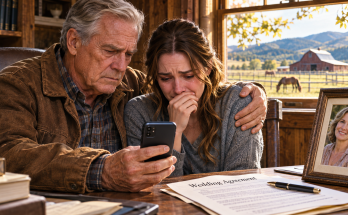
That evening, I sat alone at the kitchen table.
Clara had gone upstairs.
The house was quiet.
I was looking at Helen's chair.
She had been gone for years, but I had never stopped thinking of that place at the table as hers.
Sometimes I still expected to look up and find her sitting there.
I knew that was foolish.
I knew exactly how long she had been gone.
But there are habits that remain after a person dies.
And there are absences that never become ordinary.
That evening, I wished she were sitting across from me.
Not because I expected her to solve the problem.
Because she would have understood Clara better than I had.
Helen noticed things.
Small changes in a person's expression.
A pause before an answer.
The difference between an honest smile and one offered because someone felt uncomfortable.
I often missed those things.
I was a practical man.
Most of my life had been built around problems I could see and touch.
If a fence needed repair, I examined the damage.
If the roof leaked, I found where the water was coming through.
If an animal became sick, I looked for signs and tried to determine what was wrong.
I understood that kind of work.
You identified the problem.
You found the right tools.
You did what needed to be done.
I had always been comfortable with that.
But the situation with Julian was not something I could fix with my hands.
I could not take apart the months that had changed Clara's confidence.
I could not undo every conversation that had made her question herself.
And I could not restore her trust simply by telling her what to believe.
I looked across at Helen's empty chair.
"I missed it," I said quietly.
There was no answer.
Of course there wasn't.
But saying it aloud made the truth harder to avoid.
I had missed what was happening.
Not every sign.
I had seen some of them.
That was the part I could not excuse.
I remembered Clara hesitating during conversations.
I remembered her apologizing when nobody was upset with her.
I remembered how often she checked her phone.
At the time, I had not connected those things.
I had allowed Julian's explanation about wedding stress to settle the matter.
It had been easy.
Too easy.
I knew how busy wedding preparations could become.
I knew Clara had a great deal on her mind.
And Julian had a pleasant explanation ready whenever I noticed something.
I wanted to believe him.
So I did.
Now I wondered whether Helen would have challenged those explanations.
I thought she probably would.
She might have waited until Clara was alone.
She might have asked whether everything was all right.
She might have noticed the difference between ordinary stress and genuine fear.
Helen had always been patient when our daughter needed time to talk.
I had tried to learn that patience.
Some days I managed it.
Other days I fell back into my old habits.
I wanted answers.
I wanted problems settled.
I wanted to know what to do next.
But the recording had taught me that rushing toward a confrontation was not necessarily the same as helping.
Clara had asked me not to call Julian.
I had promised.
I intended to keep that promise.
Even though I was angry.
Especially because I was angry.
I knew what I would ask him if I had the chance.
Why had he told my daughter that my death was something she should consider when discussing property?
Why had he treated our ranch as though it were already part of his future?
Why did the agreement appear to give him authority over family assets?
And why did he believe he could influence me against Clara?
Those questions demanded answers.
But demanding them from Julian that evening was not the only way to find out.
I remembered the document.
That was where the morning's argument had begun.
Not with an accusation.
Not with Clara suddenly deciding she didn't love the man.
With paperwork.
She had read something more carefully.
She had asked a question.
And instead of explaining the terms, Julian had reacted with anger.
That was important.
I had learned to pay attention when someone became upset about a reasonable request for clarification.
It did not always mean dishonesty.
But it meant I should look more closely.
I thought about the ranch.
Our ranch.
The land my grandfather and father had worked before I took responsibility for it.
I could still picture the old fence line stretching toward the pasture.
Parts of it had been built by my father.
I had repaired those sections so many times that I could remember which posts caused the most trouble.
The property held memories that no financial statement could capture.
Helen had lived there with me.
Clara had grown up there.
There were places on that land where I could remember a conversation from decades earlier as clearly as if it had happened yesterday.
I knew the property was valuable.
I was not naïve about money.
Land could be sold.
It could be borrowed against.
Ownership could change.
People could make agreements about it.
I understood all of that.
But there was a difference between understanding the value of property and treating a family member's death as an opportunity to obtain it.
Julian had crossed that line in the recording.
I kept coming back to the same moment.
He had spoken about my age.
Then Helen's death.
Then Clara's future inheritance.
There had been no tenderness in the way he connected those things.
No concern for what losing another parent would mean to her.
That bothered me more than anything else.
Clara was still grieving her mother.
I knew that.
She had found comfort in Julian because he seemed to understand that grief.
Yet he had been willing to bring up Helen's death during an argument about money.
I could not stop thinking about it.
I looked at Helen's chair again.
The man who had once listened kindly when Clara spoke about losing her mother had now used that loss as part of an argument.
Whatever his intentions were, that was cruel.
I did not need to investigate his finances to know it.
But I did need to understand the arrangements he was making.
And I already knew someone who might help.
Sarah Vance.
Sarah had been assisting me with concerns about Julian's business connections.
Those concerns had begun before Clara showed me the recording.
We had discussed them.
Sarah had been more troubled by what she was examining than I had been willing to admit.
I had listened to her.
But I had not fully accepted that the situation might be serious.
I still believed Julian was probably the same young man who visited the ranch and asked about our family.
I wanted there to be a reasonable explanation for whatever Sarah had noticed.
I had told myself not to assume the worst.
That was sensible in principle.
But I had allowed caution to become an excuse for inaction.
The recording changed that.
It showed me how Julian behaved when he believed he could pressure Clara.
It showed me that the document concerning our property had become a source of conflict.
And it showed me that he was willing to use my daughter's relationship with me as leverage.
Those facts were no longer things I could dismiss.
I reached for my phone.
For a moment, I considered everything Clara had told me.
She had asked me not to contact Julian.
She had not asked me to ignore the paperwork.
In fact, we had agreed that understanding it was important.
I would keep my promise.
And I would find out what I could.
I called Sarah.
She answered.
I told her Clara had shown me a recording that raised serious concerns.
I did not try to make the situation sound better than it was.
I explained that the conversation involved the wedding agreement and our family property.
I told her Julian had spoken about my death and Clara's inheritance.
And I told her his response to Clara's questions had disturbed me.
Sarah listened.
She did not interrupt while I spoke.
That was something I appreciated.
I had spent the morning struggling with anger.
I needed someone willing to concentrate on the facts.
When I finished, Sarah said she wanted to visit the ranch the next morning.
I agreed.
There was more to examine.
I understood that.
The recording was important, but it did not explain every detail of the agreement.
It did not tell us exactly what Julian had arranged.
And it did not settle the concerns Sarah had already raised about his business connections.
We needed a clearer picture.
Before ending the call, I asked her the question that had been bothering me all day.
"Sarah, do you think the ranch is what he's trying to get?"
She was quiet for a moment.
I waited.
I wanted certainty.
Something simple.
Something that would tell me exactly what Julian was planning.
But Sarah did not pretend to know more than she did.
"We have to find out precisely what he's been putting in place," she told me.
I looked toward the kitchen window.
Outside, the pasture had grown dark.
I could barely see the fence beyond the house.
Still, I knew where it was.
I knew the land beyond it.
I knew the work that had gone into keeping it.
And I knew why Clara cared about it so deeply.
The ranch was part of our family history.
It connected her to Helen.
It connected both of us to the people who had come before.
Julian had spoken about it as something she would eventually inherit.
That fact alone was not unusual.
Clara knew the property would one day be hers.
What troubled me was the way he seemed to be planning around that future while I was still alive.
And the way he had reacted when she questioned his intentions.
I ended the call with Sarah.
The kitchen was quiet again.
I sat for a while without moving.
I thought about Clara upstairs.
I thought about the wedding dress.
The chapel.
The two hundred guests expecting to celebrate her marriage.
Those arrangements had seemed so important only a day earlier.
I had worried about getting everything ready.
I had imagined standing beside my daughter while she began a new life.
I had believed Julian would be there to care for her.
Now the thought of that future frightened me.
Not because I knew everything about Julian.
I didn't.
And I refused to pretend otherwise.
But I knew what I had heard.
I knew Clara had been frightened before.
I knew she had begun doubting her right to ask questions.
And I knew the man she intended to marry had been discussing our property in ways that required an explanation.
I looked again at Helen's empty chair.
For years, I had thought the hardest thing our family would face was learning how to live without her.
I had watched Clara struggle with that loss.
I had been grateful when Julian appeared to bring happiness back into her life.
Perhaps that gratitude had made me less careful.
Perhaps I had mistaken his attention for character.
I could not change what I had believed before.
But I could change what I did with the information I had now.
I would listen to Sarah.
I would examine the documents.
I would take Clara's concerns seriously.
And I would not allow my anger to drive me into a confrontation that might make things worse for her.
I had promised my daughter that we would find out what was happening.
I meant to keep that promise.
The next morning, Sarah was coming to the ranch.
We still had questions.
We still had an agreement to understand.
And there were business connections surrounding Julian that I could no longer afford to overlook.
For the first time since Clara announced her engagement, I was not thinking about the wedding as a celebration we needed to prepare for.
I was thinking about the man she was preparing to marry.
About the things he had said when he thought he could control the conversation.
About the authority he appeared to want over property that belonged to our family.
And about how close I had come to accepting his behavior without asking another question.
The wedding was less than three weeks away.
But I was finally beginning to understand that the date on the invitation was not the most important thing.
What mattered was whether Clara could trust the man waiting to marry her.
And what Julian had really been trying to arrange.
Click here to continue reading: PART 5: When Sarah Came to the Ranch the Next Morning, She Showed Me Why Julian Had Been So Interested in Our Family Property
My Daughter Had Less Than Three Weeks Before Her Wedding When One Recording Made Me Question Everything I Believed About Her Fiancé
Part 4 of 8