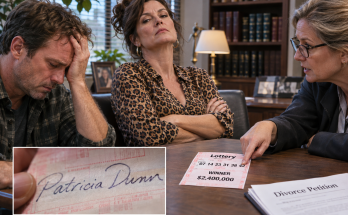
Gary stopped asking me whether I had signed the divorce papers.
At first, I thought that meant he had decided to leave the matter alone.
Then I realized he was simply waiting.
He had spent thirty-four years learning how I responded to pressure.
He knew I disliked arguments.
He knew silence made me uncomfortable.
And he knew that if he stayed angry long enough, I usually tried to make peace.
I recognized the pattern.
What surprised me was how hard it was to stop participating in it.
For several days, we moved around the house like strangers.
Gary made his coffee.
I made mine.
He watched television in the evening.
I sat at the kitchen table with my notebook and tried to organize the records Rebecca had requested.
We rarely spoke.
When we did, the conversations were short.
"Did you pay the electric bill?"
"Yes."
"Where's the mail?"
"On the counter."
Nothing personal.
Nothing kind.
Nothing that sounded like two people who had spent most of their lives together.
I had imagined divorce would involve shouting.
Crying.
Perhaps one last argument where we finally said everything we had been avoiding.
Instead, our marriage seemed to be ending in silence.
One morning, Rebecca called.
She had begun communicating with the lottery office about the disputed claim.
She explained that the office was reviewing the competing accounts and the available records.
Gary had asserted that he was entitled to claim the ticket.
I asked whether he had explained why my name was written on it.
Rebecca paused.
"He has provided his position. We need to let the evidence be examined."
I pressed my lips together.
That wasn't the answer I wanted.
I wanted to know exactly what Gary had said.
I wanted to know whether he had admitted taking the ticket from the refrigerator.
I wanted to hear him explain why he told me he hadn't seen it.
But Rebecca reminded me that we couldn't force every answer to appear at once.
I hated waiting.
Waiting gave me too much time to remember things.
The empty school envelope.
The fishing equipment.
The way Gary laughed when he talked about the divorce.
The way he looked away when I searched for the missing ticket.
I had begun seeing those moments differently.
That worried me too.
I didn't want anger to turn every memory into evidence of something terrible.
Gary had not been cruel every day.
There had been birthdays.
Family dinners.
Ordinary kindnesses.
We had laughed together.
We had raised three children.
I didn't want to pretend none of those things mattered.
But I was also beginning to understand that good memories couldn't erase what was happening now.
Rebecca asked me to bring the remaining records to her office.
I gathered the notebook.
I collected the calendars.
I checked the shoebox for receipts from the gas station.
Some had faded.
Others were folded so tightly that the creases had become permanent.
I placed each item in a folder.
Then I wrote a short account of the winning Friday.
Not an argument.
Not a statement about Gary's character.
Just what I remembered.
The gas station.
Carol.
The pineapple key ring.
The two-dollar ticket.
The drive home.
My signature.
The date.
The sentence.
The refrigerator.
I wrote everything in the order it happened.
When I finished, I read it twice.
I was surprised by how clearly I remembered that morning.
For days, Gary's accusations had made me question the simplest details.
Now, putting them on paper, I could see that my recollection hadn't changed.
The ticket had disappeared.
My memory hadn't.
At Rebecca's office, I spread the records across her desk.
She looked at the oldest notebook first.
Then the calendars.
Then the receipts.
"How long have you been keeping these?"
"Nineteen years for the numbers. Not every receipt survived."
She nodded.
"And the records show the same numbers throughout?"
"Yes."
I watched her turn the pages.
For the first time, I felt that the ordinary habits of my life might speak for me.
I had not bought a ticket because I knew it would win.
I hadn't selected the numbers after seeing the results.
I had played them for almost two decades.
The birthdays.
The anniversary.
My mother's death.
They were part of my life.
They weren't numbers Gary had chosen.
Rebecca asked about each date.
I explained its meaning.
She wrote down the connections.
I watched her work.
There was something comforting about the way she separated facts from feelings.
I had spent years listening to Gary turn every disagreement into a question about my intelligence.
Rebecca didn't do that.
She asked what could be verified.
And when I didn't know something, she simply wrote that down too.
I admitted that I couldn't prove where every missing dollar from our marriage had gone.
I didn't know what had happened to the school money.
I couldn't say why Gary had made certain financial decisions.
I couldn't explain what he had planned before taking the ticket.
But I could prove my routine.
I could describe the writing.
And I could identify the woman who sold me the winning ticket.
That was a beginning.
Rebecca told me she was also pursuing the financial information needed for the divorce.
I looked at her.
"What does that mean?"
"It means we need a complete picture of the marital finances before you make any decisions."
I thought about Gary's joke.
Half of nothing was still nothing.
I remembered how he had laughed.
For years, I had accepted his statements about what we owned.
Now someone was going to examine the records.
I asked whether that would make him angry.
Rebecca looked at me for a moment.
"His reaction doesn't determine whether you're entitled to accurate information."
I nodded.
But the question stayed with me.
I knew Gary's temper.
He didn't usually explode.
He became cold.
He spoke as though I had disappointed him.
Then he waited for me to apologize.
I was already dreading the day he discovered how much I had begun questioning.
On my way home, I stopped at the gas station.
Carol was there again.
I thanked her for remembering my purchase.
She waved the gratitude away.
"Patty, you've been coming here for years."
I smiled.
"That doesn't mean everyone would remember."
She looked at me.
"Some people pay attention."
I thought about that while driving home.
Some people did.
And some people saw only what was useful to them.
I had spent years trying to understand Gary's needs.
When he was tired.
When he was worried.
When he needed quiet.
But I couldn't remember the last time he had asked me what I needed.
That wasn't a new discovery.
It was an old feeling I had finally stopped explaining away.
A few days later, Rebecca called with another update.
The office had received supporting information about my purchasing history.
The review was continuing.
The records from the store were being examined through the appropriate process.
Carol's recollection was relevant.
The paperwork mattered.
I asked whether the lottery office had accepted my claim.
"Not yet," Rebecca said.
I tried not to sound disappointed.
She explained that the claim could not be resolved simply because one person had a convincing story.
The evidence needed to be considered together.
I understood that.
Still, I wanted the waiting to end.
That evening, Gary found me at the kitchen table.
I was organizing copies of financial documents.
He looked down at the papers.
"What's all this?"
"Records."
"What records?"
"Things I need for the divorce."
His face tightened.
"Who told you to do that?"
I looked up.
"My lawyer."
He stared at me.
"You hired a lawyer?"
"Yes."
He let out a short laugh.
"You don't need a lawyer, Patty."
"I think I do."
He picked up one of the papers.
I reached for it.
"Please put that down."
He looked offended.
"Since when do you hide things from me?"
The question almost made me laugh.
I thought about the lottery ticket.
The divorce papers.
The financial accounts I had never been encouraged to examine.
And here he was, upset because I wanted to keep my documents private.
"I'm not hiding anything," I said.
"I'm getting advice."
He dropped the paper onto the table.
"You're letting somebody fill your head with nonsense."
I felt the familiar urge to explain.
To reassure him.
To make the moment easier.
Instead, I placed the documents back in the folder.
"I'll decide that for myself."
Gary stood there for a few seconds.
Then he walked away.
I remained seated.
My hands were trembling again.
I didn't feel brave.
I felt exhausted.
But I also felt a little stronger than I had the day before.
That became the pattern.
Small conversations.
Small decisions.
One uncomfortable moment at a time.
I stopped asking Gary whether it was all right to visit Rebecca.
I stopped explaining every telephone call.
I stopped accepting statements about our finances without asking for records.
And every time I did something for myself, I felt both frightened and relieved.
I had expected independence to feel exciting.
Instead, it often felt like doing something ordinary while my heart raced.
One afternoon, I opened the old notebook to the earliest pages.
The handwriting looked younger.
I could see how carefully I had written the numbers back then.
I remembered being proud of our little family.
Our children were growing.
The house was full of noise.
Gary and I still talked about the future as though it belonged to both of us.
I wondered when that had changed.
There was no single day I could identify.
It happened gradually.
A bill I stopped asking about.
A bank statement I didn't read.
A question I swallowed because I didn't want an argument.
Those things accumulated.
Eventually, I had become a stranger to the financial details of my own marriage.
I couldn't change that history.
But I could learn what I needed to know now.
Rebecca sent me a list of documents to locate.
I went through what was available to me.
Some records were easy to find.
Others weren't.
When I couldn't locate something, I told her.
I no longer pretended to know more than I did.
And I no longer accepted that not knowing meant I was incapable of learning.
That distinction mattered.
I had worked.
I had raised children.
I had handled thousands of practical problems.
I could understand paperwork if someone explained it without making me feel stupid.
The thought made me angry.
Not at Rebecca.
At how long I had believed Gary's opinion of me.
One evening, I found myself staring at our kitchen table.
The divorce papers were no longer lying there.
They had been moved into my legal folder.
I remembered the way Gary had placed them in front of me.
The confidence.
The impatience.
The assumption that I would simply agree.
He had underestimated me.
But I had underestimated myself too.
That was harder to admit.
Because if I had been capable of learning all along, then I had surrendered more of my independence than I wanted to acknowledge.
I didn't need to punish myself for every past decision.
I did need to understand why I had made them.
I had wanted peace.
I had wanted a stable home for our children.
I had wanted the man I married to remain the man I believed he was.
Sometimes I had protected those hopes by ignoring what was happening.
Now I was paying the price.
Another week passed.
The prize claim remained unresolved.
Gary grew more impatient.
He complained about the inconvenience of the divorce.
He said lawyers made simple matters complicated.
He suggested that I was being influenced by people who didn't know our marriage.
I listened.
But I no longer mistook his frustration for proof that I was wrong.
When Rebecca called again, her voice sounded more deliberate than usual.
She explained that the evidence supporting my account had become stronger.
The purchase history and the details I had provided were being considered alongside the ticket itself.
My signed name was important.
So was the date.
And the additional writing.
I sat down.
"Does that mean they're going to recognize it as mine?"
"It means the evidence is supporting what you've told us. We still need the formal decision."
I nodded even though she couldn't see me.
"All right."
After the call, I looked at the pineapple magnet.
I had kept it beside my notebook.
The yellow paint was slightly worn.
It was an absurdly cheerful object to be connected to something so painful.
I picked it up.
For years, I had used it as a little reminder to find something sweet in ordinary life.
Now it reminded me of something else.
I could be frightened and still tell the truth.
I could be uncertain and still ask questions.
I could be hurt by Gary and still protect myself.
Those things could exist together.
That night, I didn't ask Gary whether he wanted to talk about the marriage.
I didn't try to persuade him to be kinder.
I didn't ask why he had taken the ticket.
I had already asked whether he had seen it.
He had given me his answer.
Now the records were beginning to give a different one.
And for the first time, I was willing to let the facts speak louder than my husband's voice.
Click here to continue reading: PART 7: When Gary Finally Had to Answer Questions About the Missing Ticket, I Discovered How Much of Our Marriage Had Been Built on Silence
After Thirty-Four Years of Marriage, I Thought I Knew My Husband Until Our Winning Lottery Ticket Vanished From the Refrigerator
Part 6 of 8