I wanted to tell Sophie the truth.
The difficulty was that I did not know what the truth was.
Not beyond what we could see.
Two little girls.
Both five, or close enough that I could not tell the difference.
Both with chestnut curls.
Both with gray eyes.
Both with the same face.
Everything else was uncertain.
I could describe their clothing.
I could describe the flower stand.
I could describe the way the child held her rabbit.
But I could not explain the resemblance.
That distinction had become the center of my thoughts.
I was a man who dealt in information.
I knew how to gather it.
I knew how to remember it.
I knew how to use it.
But I was beginning to understand that gathering details was not the same as knowing their meaning.
I could memorize everything about the little girl.
The red dress.
The worn shoes.
The tangled curls.
The beige rabbit.
None of those details told me why she looked like Sophie.
I wondered whether there was an explanation so ordinary that I would later feel foolish.
I wondered whether the resemblance was one of those remarkable coincidences people talked about.
But I did not know.
And I refused to turn a possibility into a fact.
That was important.
I had made too many decisions in my life based on incomplete information.
Sometimes I had been right.
Other times, I had been confident.
Those were not always the same thing.
I knew that better than most men.
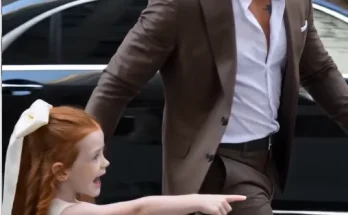
I looked at Sophie.
She was standing close to my leg.
Her cream dress brushed against the brown fabric of my suit.
I could see the curve of her cheek.
The familiar shape of her small nose.
Her lips were slightly parted.
She was still trying to understand what she had seen.
I wanted to help her.
That urge was almost physical.
I wanted to gather her questions and put them into an order she could understand.
I wanted to make the situation smaller.
Less confusing.
Less unsettling.
But I could not.
The child beside the flowers remained there.
Her face remained identical.
And my daughter knew what she saw.
I could not persuade Sophie otherwise without asking her to distrust her own eyes.
I would not do that.
I had spent years trying to make her feel safe.
But safety built on denial was not something I wanted to give her.
If she saw something confusing, I wanted her to be able to tell me.
If she asked a question, I wanted her to know I would listen.
Even when I had no answer.
Especially then.
I thought about the way she had first spoken.
"Daddy?"
That one word had carried complete trust.
She had not called for anyone else.
She had turned to me.
She expected me to understand.
I had felt proud of that trust before.
Now I felt responsible for it.
The difference mattered.
Trust was not a prize.
It was something I had to deserve.
And standing beside Sophie, I realized how easily I could damage it by pretending to know more than I did.
I could invent an explanation.
I could tell her the girls simply happened to look alike.
I could say it meant nothing.
I could insist that the situation was not important.
But how would I know?
I did not.
And Sophie deserved better than a confident answer without evidence.
I looked at the little girl again.
She was quiet.
The beige rabbit remained close to her body.
I remembered the faint sound of her voice.
It had been difficult to hear over the street.
I had listened closely.
Still, I could not honestly repeat every word.
I knew that frustration would stay with me.
The moment seemed to demand a revelation.
As though the child only needed to say one sentence and the world would return to its proper shape.
But I had no reason to believe life worked that way.
A child's whispered words might be ordinary.
They might express confusion.
They might mean something I could not anticipate.
I simply did not know.
I refused to place words in her mouth.
The thought was strangely painful.
I wanted the answer badly enough that part of me was tempted to imagine it.
But imagining an answer would not make it true.
I had to stop myself.
I looked toward the waiting car.
The black surface caught the afternoon light.
The vehicle had not moved.
Our destination was still there.
Our original plan remained possible.
I could take Sophie away.
We could leave the sidewalk.
The flowers.
The girl.
The resemblance.
At least physically.
But I knew the questions would follow.
They would remain with me whenever I looked at Sophie's face.
They would return when I saw her gray eyes.
When I brushed her curls away from her forehead.
When I remembered the ivory bow.
When I thought about the rabbit held against the faded red dress.
I could leave the street.
I could not erase what we had seen.
That was one of the hardest things for me to accept.
I had become accustomed to removing unwanted things from my life.
People who threatened me.
Situations that made me uncomfortable.
Problems that interfered with my plans.
Sometimes money was enough.
Sometimes influence.
Sometimes methods I did not want Sophie to know existed.
But none of those methods could remove a memory.
I could not purchase certainty.
I could not intimidate confusion.
I could not make a child's face become unfamiliar through force.
I had reached the limit of the tools I usually trusted.
And the realization left me strangely exposed.
I looked at my daughter.
She seemed so small beside me.
Her hand barely filled mine.
I had always been aware of that difference in size.
I was careful whenever I held her.
Careful not to squeeze too tightly.
Careful not to pull her too quickly.
Careful to adjust my pace to hers.
But I had never thought about applying that same care to her questions.
I had assumed that being a good father meant giving answers.
Perhaps sometimes it meant admitting that I did not have them.
Perhaps it meant allowing Sophie to feel confused without making her feel foolish.
I considered that.
It did not come naturally.
I was accustomed to speaking with certainty.
I was accustomed to deciding what things meant.
But I wanted Sophie to grow into someone who could recognize uncertainty without fearing it.
I wanted that for her.
Even if I had not learned it myself.
I looked toward the flower stand again.
The child was still wearing the faded red dress.
Her shoes still looked worn.
Her hair was still untidy.
Nothing had changed.
Yet I was looking at her differently.
At first, I had treated her resemblance to Sophie as the most important thing about her.
Then I had started noticing her clothing.
Now I was trying to remember that she was a person beyond both.
She existed independently of my shock.
She had a name I did not know.
A life I did not know.
Thoughts I could not read.
And whatever she had whispered belonged to her until I heard it clearly enough to understand.
That realization humbled me.
I had known powerful men who thought every room belonged to them because they could control what happened inside it.
I had sometimes been one of those men.
But the sidewalk did not belong to me.
The flower stand did not belong to me.
And the little girl certainly did not belong to me.
I was simply standing there with Sophie.
Trying to understand.
I looked at my daughter's face.
Then at the girl's.
The resemblance remained astonishing.
No amount of reflection changed that.
They looked like the same child.
Two different dresses.
Two different places to stand or sit.
Two sets of little hands.
One holding mine.
One holding a rabbit.
I felt the questions rise again.
Who was she?
Why did she look like Sophie?
What did her whisper mean?
I had no answers.
I could feel my old impatience returning.
That familiar urge to move the situation forward.
To make someone speak.
To refuse to leave without certainty.
I recognized it.
And this time, I did not obey it.
I let the questions exist.
That was not a heroic act.
It was a small act of restraint.
But for me, it mattered.
I was learning that not every uncertainty was an enemy.
Not every silence needed to be broken by force.
And not every person who puzzled me was responsible for resolving my confusion.
Sophie shifted her fingers inside mine.
I looked down.
She was still watching the other child.
I wondered whether she might someday understand how much that afternoon had affected me.
Not because of anything the girl had done.
Not because of anything threatening.
But because the encounter had forced me to see myself without the comfort of power.
I was simply a father.
A confused father.
A father who loved his daughter and did not know how to answer her question.
For once, I allowed that to be true.
I looked toward the girl in red.
Her rabbit rested against her dress.
Her gray eyes were still familiar.
And I understood that whatever explanation might exist, I had not yet earned the right to claim it.
Click here to continue reading: PART 12: I Looked Into the Stranger’s Gray Eyes Again and Realized That Whatever Her Whisper Meant I Could Not Pretend I Had Heard It
I Thought I Could Protect My Daughter From Anything Until She Let Go of My Hand on a Chicago Sidewalk
Part 11 of 20