
I had spent my life believing that every question had an answer if a man was powerful enough to demand it.
That afternoon proved me wrong.
I was standing on a Chicago sidewalk.
My daughter was beside me.
A little girl sat near the flower stand.
And I did not know why their faces were identical.
I had looked at them for what felt like far too long.
I had searched for differences.
I had questioned my own eyes.
I had tried to make sense of their clothing, their expressions, and the little details that separated them.
Nothing had explained what I saw.
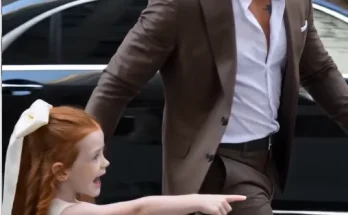
Sophie wore a cream-colored dress.
An ivory bow rested in her chestnut curls.
Her gray eyes were wide with uncertainty.
She was five years old.
She was my daughter.
The other child looked the same age.
Her dress was faded dark red.
Her shoes were worn.
Her chestnut curls were untidy.
She held a beige stuffed rabbit.
And she had the same face.
I looked at one child.
Then the other.
I had done that so many times that I almost felt ashamed.
But the resemblance remained impossible to dismiss.
The same eyes.
The same nose.
The same mouth.
The same face.
I had never seen anything like it.
I wanted to tell Sophie why.
I could not.
That was the truth.
Not an impressive truth.
Not a comforting one.
But the only honest answer available to me.
I looked down at her.
Her hand was still inside mine.
I could remember exactly how it had felt when she first pulled away.
The sudden emptiness of my palm.
The sharp movement of my head.
The instinctive reach toward my weapon.
I had believed someone was threatening her.
I had been ready to confront an enemy.
Then I followed her pointing finger.
And I saw the little girl.
That moment had changed everything about the afternoon.
I had arrived on that street as a man accustomed to controlling his surroundings.
I had believed that my reputation, my precautions, and my resources could prepare me for almost anything.
I was wrong.
A five-year-old child sitting beside some flowers had shown me the limits of my certainty.
She had done nothing threatening.
She had not approached us.
She had not asked me for anything.
She had simply existed in a place where Sophie could see her.
And that had been enough to stop me.
I looked toward the flower stand.
The bright arrangements stood above the child.
The concrete beneath her remained dirty.
Her rabbit rested against her faded dress.
I had spent so much time looking at those details.
Trying to understand what they meant.
Trying to imagine what her life might be like.
But I had no facts to support those imagined stories.
I did not know where she lived.
I did not know who cared for her.
I did not know her name.
I did not know whether she had ever seen another child who resembled her.
I knew only what my eyes had shown me.
And I had finally learned not to pretend that was more than it was.
The girl had whispered.
I remembered that too.
Her voice had been very quiet.
The noise of the street had made the words difficult to hear.
I had listened carefully.
But I could not honestly repeat the entire sentence.
That uncertainty remained.
I had wanted her words to solve everything.
I had wanted a revelation.
Something that would explain the resemblance and restore order to my thoughts.
But I could not claim an answer I had not heard.
I would not invent one.
Not for myself.
Not for Sophie.
And not for the child who had spoken.
I looked down at my daughter.
Her face was still turned toward the girl.
I wanted to say something that would help her.
I thought about every confident answer I had given people in my life.
Every order.
Every promise.
Every statement meant to make someone believe I knew exactly what I was doing.
Those habits had built my reputation.
But they could not help me here.
Sophie did not need a performance.
She needed honesty.
I lowered my attention to her.
"Sweetheart, I see it too."
She looked up at me.
I glanced once more toward the little girl.
"I don't know why she looks so much like you."
The words were simple.
Almost embarrassingly simple.
But I had spent the entire encounter struggling to say them.
I did not know.
That was all.
No explanation.
No confident conclusion.
No promise that everything would make sense later.
I could not give her those things honestly.
So I gave her the truth.
I looked toward the other child.
She still held the rabbit.
I wondered whether she had heard me.
I could not tell.
I did not want to frighten her by continuing to stare.
I had already given her more attention than she had asked for.
I knew that.
I looked back at Sophie.
The ivory bow in her hair had become one of the details I knew I would always remember.
That bow.
The red dress.
The beige rabbit.
The flowers.
The black car waiting ahead.
They were all ordinary things.
Yet together, they had become part of the strangest afternoon of my life.
I had spent years measuring important moments through danger.
An enemy moving against me.
A threat to my business.
A decision that could cost someone everything.
I had believed those were the moments that revealed a man's character.
But now I thought about the way I had reacted when Sophie pulled away.
I had reached toward a weapon.
I had expected violence.
And when I discovered there was no attacker, I had been left with a situation I could not control.
My first instinct had failed me.
Not because caution was always wrong.
But because I had allowed suspicion to become my natural way of understanding the world.
That was a cost I had not considered carefully enough.
I had brought the habits of my criminal life into an afternoon with my daughter.
I could not pretend otherwise.
I wore the brown suit.
The tattoos showed above my open white shirt.
The armored car waited for us.
Everything about my appearance and my precautions reflected the life I had chosen.
But Sophie was not responsible for those choices.
Neither was the girl in red.
I had to remember that.
I looked toward the child once more.
Her old shoes were still visible beneath her dress.
I had initially thought of her clothing as evidence.
Evidence of poverty.
Evidence of difficulty.
Evidence of a life different from Sophie's.
But I had been too quick.
I could see the condition of the clothes.
I could not see the whole life behind them.
I could not know what the rabbit meant to her.
I could not know who loved her.
I could not know what circumstances had brought her to that sidewalk.
Those things remained hidden.
And I had no right to invent them.
I had learned something important about the way I judged people.
I did not like what I had discovered.
For years, I had believed I could understand someone by studying the details.
Their clothes.
Their expression.
Their posture.
Their possessions.
I had become very good at noticing.
But I had sometimes confused noticing with knowing.
The two were not the same.
The girl beside the flowers had made that distinction impossible to ignore.
I knew her face perfectly.
I knew almost nothing about her.
And no amount of staring could change that.
I looked at Sophie.
She was my daughter because of our lives together.
Because of the relationship we shared.
Because I knew her voice, her laughter, and the little things that made her herself.
The other girl had the same face.
But she was a separate person.
She had her own life.
Her own experiences.
Her own name, though I did not know it.
Her resemblance to Sophie did not erase that.
I was ashamed that it had taken me so long to understand.
At first, I had seen a mystery.
Then a possible explanation waiting to happen.
Only afterward had I begun to see the little girl herself.
A child holding a rabbit.
Someone who deserved gentleness whether or not I understood why she looked like my daughter.
I thought about what Sophie might learn from watching me.
She was five.
She noticed more than I sometimes expected.
She had noticed the girl before I did.
She had noticed the resemblance without needing anyone to explain it.
And she had turned to me with her question.
I wanted her to keep that curiosity.
I did not want her to inherit my suspicion.
I did not want her to believe that every unfamiliar situation was dangerous.
I did not want her to think strength meant forcing people to answer questions.
I wanted her to see that a person could be uncertain and still behave with care.
That was the lesson I needed to learn myself.
I looked toward the waiting car.
Its black armored body remained ahead.
It had been there from the beginning.
Ready to take us away from the shopping district.
I could still help Sophie inside.
I could still continue our afternoon.
But I knew that leaving the street would not erase the encounter.
I would remember it.
I would remember Sophie's sudden movement.
The little finger pointing toward the curb.
My own fear.
The girl in the red dress.
The rabbit.
The whisper.
And the two identical faces.
Those memories would remain whether I understood them or not.
I had to accept that.
I could not control everything that entered my daughter's life.
I could not guarantee that every question she asked would have an answer I could provide.
I could not protect her from every confusing experience.
But I could choose how I stood beside her when those experiences came.
I could listen.
I could tell the truth.
I could admit uncertainty.
And I could refuse to make an innocent person responsible for my fear.
Those were things I could do.
They were not grand acts.
They would not impress the men who feared my name.
They would not strengthen my position in Chicago.
They would not add anything to my wealth.
But they mattered to Sophie.
And that made them important to me.
I looked down at her once more.
Her small hand was warm in mine.
I had spent years believing that my strength came from being able to make other people obey me.
Now I was beginning to understand that sometimes strength required me to control only myself.
My impatience.
My suspicion.
My desire for certainty.
My fear of appearing weak.
Those were things I could confront without harming anyone.
I looked at the girl beside the flowers.
Her face remained identical to Sophie's.
I could not explain it.
The question was still unanswered.
And I knew that no amount of reflection could turn the incomplete account of that afternoon into a confirmed explanation.
Whatever the resemblance meant, the truth had not been revealed to me.
I would not pretend otherwise.
The girl's whispered words remained unclear.
Her identity remained unknown.
Her connection to Sophie, if there was one, remained uncertain.
Those were the limits of the story I could truthfully tell.
I had wanted a complete answer.
I had wanted to know why two little girls on the same sidewalk shared a face.
But wanting an ending did not give me the right to manufacture one.
I looked at Sophie.
Then at the girl in red.
I thought about the distance between them.
Only a few feet.
Yet I knew almost everything about one child and almost nothing about the other.
That was the contrast I would remember most.
Not simply rich clothing and worn clothing.
Not an ivory bow and a stuffed rabbit.
But the difference between familiarity and knowledge.
I recognized the girl's face.
I did not know her.
I knew Sophie's face.
And I knew Sophie.
Those truths could exist together.
I did not have to deny either one.
For once, I allowed the world to remain larger than my understanding of it.
The sunlight continued falling across the sidewalk.
People walked past the expensive shops.
The flowers remained bright.
The car was still waiting.
And I stood beside my daughter, no longer reaching toward my weapon, no longer preparing to confront an enemy.
I was simply holding her hand.
I was looking at another child.
I was accepting that I did not know the answer.
The encounter had not given me the explanation I wanted.
It had given me something less comfortable.
A clear view of my own limits.
And of the difference between the father I had been and the father I wanted to become.
I could not change what Sophie had seen.
I could not make the other girl's face unfamiliar.
I could not tell the world to arrange itself according to my expectations.
But I could remember the child behind the resemblance.
The girl in the faded red dress.
The girl with the worn shoes.
The girl holding the beige rabbit beside the flowers.
She was not a threat.
She was not a problem that belonged to me.
She was a child.
And my daughter had been the one who made me see her.
That was the truth I carried from the moment.
Not an explanation of the identical faces.
Not a discovered relationship.
Not a secret I could prove.
Only the knowledge that my little girl had stopped because she saw another person, and her father had been forced to recognize how much he still had to learn.
I held Sophie's hand gently.
The questions remained.
But I no longer mistook the absence of answers for a reason to abandon kindness.
And on that bright Chicago afternoon, that was the only ending I could honestly give to what I had seen.
The End
Read more original stories on Feel Every Story.
I Thought I Could Protect My Daughter From Anything Until She Let Go of My Hand on a Chicago Sidewalk
Part 20 of 20

One Comment on “PART 20 – Two Little Girls Shared the Same Face on That Chicago Sidewalk, and I Finally Faced the Truth I Could Honestly Tell My Daughter”