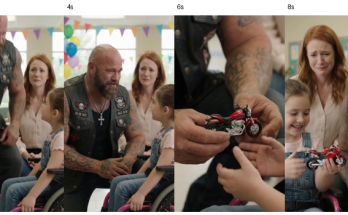
THE BOY BROUGHT AN OLD LUNCHBOX TO A TABLE OF BIKERS
“WHICH ONE OF YOU IS MACK?”
Every man at the booth stopped eating.
The boy standing beside their table couldn’t have been more than nine.
His name was Eli Turner.
He wore faded jeans, an oversized blue sweatshirt, and both hands were wrapped around the handle of an old RED METAL LUNCHBOX.
Four large motorcycle riders sat in the booth.
Leather work vests.
Heavy boots.
Gray beards.
Tattooed forearms.
The biggest man among them slowly lowered his coffee.
He was in his late fifties, broad-shouldered, with a silver beard and weathered hands.
“That’s me.”
Eli looked at him carefully.
“Mack?”
The man nodded.
“Mack Harris.”
Eli placed the lunchbox on the table.
“My grandpa told me to give you this.”
Mack’s expression changed.
“Your grandpa?”
Eli opened the metal latch.
CLICK.
There was no lunch inside.
No sandwich.
No juice box.
Instead, the lunchbox contained an old pair of brown work gloves, a folded photograph, and a small yellow envelope.
One of the men beside Mack stopped chewing.
Mack stared at the gloves.
A triangular patch of RED fabric had been sewn across the left wrist.
He reached for them slowly.
“Where did you get these?”
“They were Grandpa’s.”
Mack turned one glove over.
His thumb stopped against the red patch.
For several seconds, he said nothing.
Then he looked at Eli.
“What was your grandfather’s name?”
“Walter Turner.”
The diner suddenly seemed quieter.
The biker sitting opposite Mack lowered his fork.
Another man looked directly at him.
Mack whispered:
“Walter.”
Eli nodded.
“He said you’d remember the gloves.”
Mack leaned back slightly.
“I remember.”
He looked at the faded patch again.
“Your grandfather tore these open pulling me out from under a steel beam.”
Eli’s eyes widened.
“When?”
“Long before you were born.”
Mack picked up the photograph.
Five young construction workers stood beside the unfinished framework of a bridge.
Their clothes were dirty.
Their hard hats were scratched.
A much younger Mack stood second from the left.
Walter Turner had one arm around his shoulder.
Eli leaned forward.
“That’s Grandpa.”
Mack smiled faintly.
“Yeah.”
Then the smile disappeared.
“Where is he?”
Eli looked down at the lunchbox.
“He can’t come anymore.”
Mack understood before the boy said anything else.
His hand tightened slightly around the photograph.
Eli continued quietly.
“He got sick last winter.”
Nobody at the booth moved.
“He kept this lunchbox under his bed.”
Mack lowered his eyes.
“When?”
“Three weeks ago.”
The man beside Mack removed his cap.
Eli reached toward the yellow envelope.
“He told my mom I had to bring this here if anything happened.”
Mack looked at him.
“Your mother knows you’re here?”
Eli nodded toward the diner entrance.
A woman stood nearby watching him, one hand wrapped around a coffee cup.
“She’s waiting over there.”
Mack relaxed slightly.
Eli pushed the envelope toward him.
“This part is for you.”
Mack opened it.
Inside was one sheet of paper.
Only a few lines had been written.
The handwriting shook toward the end.
Mack read the first sentence.
Then stopped.
The biker beside him leaned forward.
“What is it?”
Mack didn’t answer.
He read it again.
Then turned the paper slightly.
Eli couldn’t see every word.
But he could see the final line.
TAKE CARE OF THE BOY IF I CAN’T.
Mack closed his eyes for one second.
When he opened them again, Eli was staring at the old photograph.
“Did you really know my grandpa?”
Mack set the letter down.
“He saved my life.”
Eli looked up.
“Really?”
“Really.”
Mack glanced toward Eli’s mother.
She looked nervous.
Tired.
And embarrassed to be standing there at all.
Mack looked back at the boy.
“What did you eat today?”
Eli hesitated.
“Cereal.”
“For lunch?”
Eli shook his head.
Mack pushed his plate aside.
“Did you eat lunch yet?”
Another small shake of the head.
Mack reached beside him.
He pulled the empty chair away from the table.
“Sit down.”
Eli looked at the other men.
Nobody objected.
Instead, the biker with the longest beard slid closer to the wall.
Another pushed the basket of fries toward the empty seat.
Eli looked back at his mother.
She gave a small nod.
He climbed into the booth.
Mack handed him a menu.
“What do you like?”
“Cheeseburgers.”
“Good answer.”
For the first time since entering the diner, Eli smiled.
Mack signaled the waitress.
“One cheeseburger.”
Eli quickly added:
“No onions.”
Mack nodded seriously.
“No onions.”
The men laughed softly.
Then Mack picked up Walter’s letter again.
He turned it over.
There was something written on the back.
His expression changed.
Eli noticed immediately.
“What?”
Mack stared at the final paragraph.
Walter hadn’t only asked him to watch over Eli.
He had left Mack one more request.
One that involved all four men sitting at that table…
and a place they had promised Walter they would never return to.
Mack folded the letter carefully.
Then looked at Eli.
“Finish your lunch.”
“Why?”
Mack glanced at the other men.
One by one, they understood.
Because after lunch, they were taking Eli somewhere his grandfather had been trying to show him for nine years.
And Eli had no idea what was waiting there.
THE TEN-YEAR-OLD GIRL WHO BROUGHT A COFFEE CAN OF COINS TO FIX HER MOM’S RAMP — AND THE NAME THAT MADE SIX BIKERS DROP THEIR TOOLS
Marcus did not let Lily ride in the truck yet.
Not until he made one phone call.
“Your mother’s number?”
Lily immediately looked worried.
“She’s going to be mad.”
“She should know where you are.”
“But then she might say no.”
Marcus crouched slightly.
“Kid, six strangers showing up at someone’s house with saws is exactly the kind of thing your mom gets to say no to.”
Fair.
Lily slowly gave him the number.
Marcus called.
A woman answered on the fourth ring.
“Hello?”
“Sarah Parker?”
“Yes.”
“My name’s Marcus Hale.”
Silence.
Then:
“Marcus?”
That stopped him.
“You know who this is?”
Sarah gave a short, surprised laugh.
“I’d recognize that voice anywhere.”
Marcus looked toward the other men.
They were listening now.
He glanced at Lily.
“She came to our garage.”
Another silence.
Then Sarah’s voice changed.
“Lily did what?”
“She brought a photograph of your ramp.”
“Oh no.”
“And a coffee can.”
Sarah exhaled.
“Please tell me she didn’t spend her lunch money.”
“She tried.”
Marcus looked at the can in Lily’s arms.
“She still has every cent.”
Good.
Then he told Sarah why he was calling.
Not:
We are coming whether you like it or not.
He asked permission.
Sarah was quiet for several seconds.
Finally:
“The ramp really is bad.”
“Can we look at it?”
“Yes.”
“Repair if it’s appropriate?”
Another pause.
Then:
“Yes.”
Marcus handed the phone to Lily.
Her mother’s voice became firmer.
“Library?”
Lily looked at the floor.
“I was going there after.”
“Lily.”
“Sorry.”
“We’ll talk when you get home.”
Lily winced.
Marcus almost smiled.
Almost.
Then Sarah added:
“And you are not riding on a motorcycle.”
Marcus said from beside her:
“Pickup truck.”
“Seat belt?”
“Yes.”
“Then bring her home.”
Permission.
Clear.
Only then did the crew load the tools.
When they reached the blue house, Marcus noticed the plaque immediately.
WILLOW STREET CLINIC — VOLUNTEER ACCESS PROJECT.
Old brass.
Weathered.
Still readable.
Sarah Parker waited inside the doorway in a wheelchair.
She was forty-two.
Dark hair pulled back.
Blue sweater.
Calm face.
She looked at Marcus.
Then at Dean.
Then Eddie.
For a moment, nobody spoke.
Finally Sarah said:
“You all got old.”
Dean laughed.
“You didn’t.”
“That’s because you haven’t seen me in twenty-two years.”
Lily looked between them.
“You really know my mom?”
Marcus nodded.
Sarah answered before he could.
“They were younger.”
“That doesn’t answer it.”
Sarah smiled.
“Yes.”
“I knew them.”
Lily stared at her mother.
“How?”
Sarah looked toward the old plaque beside the door.
Then back at the men.
“Because before they had a garage, they had nowhere to work.”
Marcus’s expression changed.
And Lily realized the broken ramp was only the newest chapter of a story that had started long before she was born.