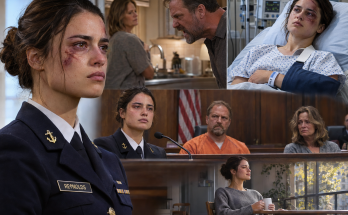
For most of my life, I confused endurance with courage.
I thought the strongest person in a room was the one who could suffer without making anyone else uncomfortable.
It took me years to understand how dangerous that belief was.
My name was Ava Reynolds.
I was a lieutenant in the United States Navy.
Remaining composed in difficult circumstances was something I had worked hard to learn.
When other people became nervous, I knew how to concentrate.
When something went wrong, I understood the importance of making decisions instead of surrendering to panic.
I had earned my position.
I was proud of it.
But shortly after two in the morning, none of those accomplishments seemed to matter.
I was lying on the floor of my apartment, struggling to breathe without hurting myself.
My stepfather was beside me.
Richard Lawson.
The man responsible for putting me there.
And instead of helping me, he was explaining what I needed to say about my injuries.
"Just say you slipped."
I stared at him.
My shoulder felt as though something inside it had been pulled apart.
Every breath brought another sharp reminder that my ribs were injured too.
There was blood near the kitchen.
One of my chairs had fallen over.
The apartment door was damaged.
I had wanted that apartment to be a place where I could finally relax.
Somewhere I could close the door without worrying about the person on the other side.
Now Richard was kneeling in the middle of everything he had ruined.
"Nobody needs to know we had a disagreement."
He sounded remarkably calm.
I almost preferred it when he shouted.
At least then I knew what was happening.
When Richard lowered his voice, I knew he wanted something.
Usually, he wanted me to agree with his version of events.
He wanted me to pretend that whatever had happened was less serious than it actually was.
And he wanted me to do it before anybody else had an opportunity to ask questions.
I had been doing that since childhood.
Sometimes without even realizing it.
I looked at the overturned chair.
Then I looked at the blood.
Neither seemed particularly interested in his explanation.
"Ava, listen to me."
I didn't answer.
He studied my expression.
I recognized the impatience building beneath his carefully controlled voice.
Richard was accustomed to receiving cooperation from me.
He expected it even when I was frightened.
Especially when I was frightened.
He had spent years teaching me that disagreeing with him could make an unpleasant situation considerably worse.
I had learned those lessons well.
Too well.
Even after leaving home, I sometimes found myself apologizing when I hadn't done anything wrong.
I would explain ordinary decisions as though I needed permission to make them.
I would notice somebody's disappointment and immediately wonder what I could do to correct it.
Those habits hadn't disappeared when I joined the Navy.
They had simply become less visible.
Richard knew exactly where to find them.
"You've got a reputation to think about."
His eyes remained fixed on mine.
"Imagine what this could do to your career."
There it was.
He wasn't concerned about my shoulder.
He wasn't concerned about the blood.
He was concerned that I might tell somebody how those injuries had happened.
And he understood that threatening my career might keep me quiet.
For years, my work had represented independence.
I had studied.
I had completed my training.
I had earned responsibilities that once seemed impossibly far beyond my reach.
My achievements belonged to me.
Richard had no part in deciding whether I deserved them.
Yet there he was, trying to make me believe that protecting everything I had built required protecting him.
I shifted slightly.
The pain was immediate.
I stopped moving and waited for it to settle.
Richard leaned toward me.
I couldn't bear the thought of him getting any closer.
"Stay back."
The words came out weaker than I intended.
He hesitated.
His expression changed in a way I remembered from childhood.
He looked offended.
Not frightened by my condition.
Not ashamed.
Offended that I had told him what to do.
For a moment, I thought he might begin another argument.
Instead, he stared at me as though he couldn't understand why I wasn't behaving properly.
That was how Richard regarded obedience.
He believed it was something I owed him.
He didn't distinguish between respect and fear.
And he certainly didn't believe that being an adult gave me the right to refuse him.
I kept watching his hands.
I wanted to put more distance between us, but my body wouldn't cooperate.
The floor beneath me was uncomfortable.
I could feel myself trembling.
I hated that he could see it.
Part of me still wanted to demonstrate that I wasn't afraid.
Another part knew perfectly well that I was.
I had spent years believing those two things couldn't exist together.
That I couldn't be competent and frightened.
That I couldn't be independent and still carry the effects of my childhood.
Lying there, I no longer had the energy to maintain that distinction.
I was injured.
I needed help.
Those were facts.
Richard seemed determined to turn them into an argument about loyalty.
"Is this how you're going to treat me?"
I said nothing.
"After all the things I've done for this family?"
I knew the direction the conversation was taking.
He would remind me of everything he believed I owed him.
He would turn my pain into evidence of my ingratitude.
Eventually, if I allowed him enough time, we would somehow arrive at the conclusion that I was responsible for upsetting him.
I had watched that transformation happen countless times.
When I was young, I hadn't possessed the words to describe it.
I had simply believed that grown-ups knew more than children.
Richard was a grown-up.
My mother was a grown-up.
If they both behaved as though I was the problem, I assumed they must understand something I didn't.
Growing older had complicated that belief.
Leaving home had weakened it.
But destroying it completely was another matter.
Richard still knew how to make me question myself.
Even that night, with the damage surrounding us, some small part of me wondered whether refusing him would make everything worse.
I was ashamed of how familiar that feeling was.
I shouldn't have needed permission to acknowledge my own injuries.
I shouldn't have been calculating the consequences of telling the truth.
But I was.
Richard began speaking again.
He didn't finish.
A heavy sound came from the apartment entrance.
It was loud enough to interrupt both of us.
Richard turned his head.
So did I.
For the first time since he had begun explaining what I needed to say, his attention was somewhere other than my face.
Then a voice came from beyond the damaged door.
"Get away from her. Now."
The command was unmistakable.
Richard moved backward.
I watched him put distance between us.
He hadn't done that when I asked.
He did it when somebody else ordered him to.
That difference stayed with me.
There was movement outside the apartment.
I heard footsteps.
More voices.
Then the damaged door opened farther.
Two military police officers came through it.
Another man followed, bringing medical equipment.
I recognized what was happening, but it took me several moments to understand what it meant.
Someone had come.
Not to ask me to explain myself to Richard.
Not to persuade us to settle our disagreement privately.
Someone had actually come to help me.
One officer approached Richard.
The other moved into the space between him and me.
I could no longer see Richard as clearly.
For years, I had tried to create that distance on my own.
I had moved away.
I had built a career.
I had established a home.
Yet somehow Richard had still managed to reach me.
Now there was a uniformed officer standing between us.
I didn't have to negotiate for that protection.
I didn't have to promise Richard anything in exchange for it.
I didn't even have to stand up.
I remained on the floor, listening to the movement around me.
The man carrying medical equipment approached.
An officer asked whether anyone else was in the apartment.
Everything seemed to be happening at once.
But one thing was immediately clear.
Richard was no longer the person giving instructions.
For the first time that night, someone else was telling him what to do.
Click here to continue reading: PART 2: My Stepfather Tried to Explain Away the Blood and Broken Furniture, but the Officers Refused to Accept His Version
I Had Learned to Stay Calm Under Pressure, but Nothing Prepared Me for the Man Kneeling Beside Me That Night
Part 1 of 10