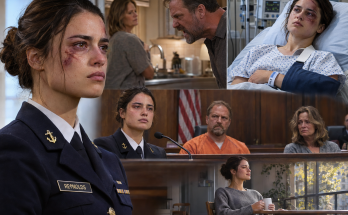
Richard had almost reached the doorway when he brought up my mother.
"Just wait until your mother hears what you've done."
The words reached me immediately.
I wished they hadn't.
After everything that had happened, after the officers had entered and restrained him, I still reacted to the possibility of disappointing her.
I felt it somewhere deeper than the pain in my shoulder.
Richard knew exactly what he was doing.
He knew that my relationship with my mother remained unfinished in my mind.
I had spent years wanting something from her that she had never given me.
I wanted her to acknowledge what had happened when I was young.
I wanted her to tell me that she understood why I had been afraid.
Most of all, I wanted to know that she would choose to protect me.
I had waited for that choice throughout my childhood.
Growing older hadn't completely extinguished the hope.
Even after leaving home, some part of me believed she might eventually understand.
Perhaps she needed time.
Perhaps she needed to see things more clearly.
Perhaps my independence would make it easier for her to admit what she hadn't been able to admit when I lived with them.
I had allowed myself countless explanations.
Richard understood that hope better than I wanted to acknowledge.
He knew mentioning my mother could make me reconsider almost anything.
And he had saved her for the moment when his other arguments stopped working.
I remembered her standing in that kitchen.
Her back turned.
The water running.
My younger self waiting nearby.
I hadn't understood then why I needed to wait.
I had simply believed she would turn around eventually.
I carried that expectation for years.
Even when I no longer lived in her house.
Even when I wore a uniform and held responsibilities that would once have seemed impossible.
Richard had found a way to remind me of it while I lay injured in my own home.
"She's going to hold you responsible for this."
I looked toward him.
The officers were beside him.
His hands remained restrained.
He couldn't reach me.
But the accusation still hurt.
I hated that.
I wanted to be finished with the feeling.
I wanted to hear him mention my mother and experience nothing more than disappointment at his behavior.
Instead, I felt the familiar pull of guilt.
The old instinct to make things right.
The desire to prevent another family argument before it began.
For a moment, I considered what my mother might say when she learned about the officers.
I imagined having to explain myself.
I imagined the questions.
I imagined the pressure to describe the incident in a way that made it easier for her to accept.
Those possibilities felt familiar.
But the apartment surrounding me was unfamiliar.
My shoulder hurt.
My ribs hurt.
The door was broken.
Chief Hayes was kneeling beside me.
An officer was recording the damage.
All of those things were happening in front of me.
I wasn't remembering an old argument.
I wasn't exaggerating some childhood disappointment.
I was a grown woman who had been injured by the man standing near the entrance.
And he was still trying to make his situation my responsibility.
I looked at Richard.
For a brief moment, he stopped speaking.
He seemed to be waiting.
Perhaps he expected me to tell the officers that I had changed my mind.
Perhaps he believed I would ask them to release him.
Perhaps he thought mentioning my mother would make me behave exactly as I had when I was a little girl.
I couldn't know which explanation was correct.
I only knew what I wanted to say.
"I asked these people for help."
My voice was still weak.
I continued anyway.
"They came. That's more than you ever did."
Richard's expression shifted.
I watched him absorb my words.
I hadn't shouted.
I hadn't threatened him.
I hadn't told him what I hoped would happen to him.
I had simply acknowledged that when I needed protection, somebody had provided it.
The officers continued moving him toward the hallway.
He began speaking again.
I couldn't concentrate on everything he said.
His voice gradually moved farther away.
Then it became quieter.
I kept looking toward the doorway.
For years, that had been my instinct whenever Richard left a room angry.
I listened for his return.
I tried to determine whether he was getting closer or farther away.
I wondered whether I had enough time to prepare for another argument.
I considered what I might say to prevent another confrontation.
That night, I listened to his voice fading.
But I didn't try to follow him.
I didn't ask where he was going.
I didn't call after him.
I didn't offer another explanation.
I remained exactly where Chief Hayes wanted me to stay.
There was work to do.
The medical personnel needed to move me safely.
Chief Hayes communicated with the others.
I listened without trying to take charge.
My body was beginning to feel heavy with exhaustion.
Everything seemed to require effort.
I remembered sending the emergency signal during the attack.
It had gone through the Navy system.
I had managed to request assistance despite what was happening.
The signal had reached people capable of responding.
Its location had brought them to my apartment.
I thought about how difficult it had been to send it.
Not because I believed asking for help was professionally unacceptable.
I knew better than that.
In my work, recognizing when additional assistance was necessary was part of making responsible decisions.
I understood the importance of communication.
I understood that emergencies needed immediate attention.
Yet applying those same principles to my private life had been another matter.
Richard had spent years making me feel that involving other people in his behavior was an act of disloyalty.
I had learned to handle things privately.
To minimize.
To explain.
To keep the unpleasant details inside the family.
Even when keeping them there meant continuing to suffer.
Sending that signal had contradicted everything Richard expected from me.
It had felt frightening.
But I had done it.
And now I could see what that decision had accomplished.
There were people in my apartment who took my injuries seriously.
Richard was no longer beside me.
I wasn't required to persuade him to stop hurting me.
I didn't need to discover a perfect explanation that would finally make him understand what he was doing.
Other people had intervened.
For most of my childhood, I had imagined protection as something that would happen only after I successfully convinced my mother.
I needed her to believe me.
I needed her to recognize the situation.
I needed her to decide that what Richard was doing was wrong.
That belief had kept me waiting.
Even after I became an adult, I sometimes behaved as though I still needed her approval to acknowledge what I had experienced.
But the officers hadn't required her permission.
Chief Hayes hadn't asked her whether my injuries were serious.
Nobody had called upon Richard to determine whether I deserved medical attention.
They had responded because I had asked for help.
That realization was difficult to separate from grief.
I thought about the little girl standing near the kitchen counter.
How long she had waited.
How carefully she had listened to the adults around her.
How completely she had believed that their decisions determined whether her pain mattered.
I couldn't change what had happened to her.
I couldn't go back and tell her that she didn't need to earn the right to be protected.
But I could stop living according to the rules she had been taught.
I had already taken one step.
I had sent the signal.
Then I had told Chief Hayes about my childhood.
Neither decision could erase what Richard had done.
But both meant that I was no longer helping him conceal it.
The medical team continued preparing me for transport.
I looked around my apartment one more time.
The overturned chair.
The kitchen floor.
The damaged entrance.
Everything I would once have wanted to hide was visible.
I didn't like looking at it.
I didn't want those things to become part of how I remembered my home.
But I no longer felt responsible for making the room appear normal.
There was nothing normal about what had happened.
Pretending otherwise wouldn't protect me.
It would only protect Richard.
Chief Hayes remained nearby.
I concentrated on his instructions.
When the medical team began moving me, the pain intensified.
I closed my eyes briefly and pressed my lips together.
I wanted to get through that moment without making a sound.
Then I realized I didn't need to prove anything by staying quiet.
If something hurt, I could say so.
If I needed them to be careful, I could tell them.
Nobody was asking me to demonstrate my strength by concealing my condition.
I had never appreciated how different that felt.
I opened my eyes.
The damaged doorway was ahead of me.
Beyond it, I could see the hallway.
There were voices outside.
The privacy I had once valued so much was gone.
Strangers knew something had happened inside my home.
They knew I had been injured.
They knew Richard had been there.
They knew enough to understand that the situation required intervention.
I had spent years believing that such exposure would destroy my dignity.
Instead, I felt something I hadn't expected.
Relief.
Not complete relief.
There were still too many unanswered questions.
I didn't know the full extent of my injuries.
I didn't know what would happen to Richard.
I didn't know whether my mother would finally acknowledge what he had done or find another reason to defend him.
I didn't know when I would be able to return to work.
Those uncertainties frightened me.
But they belonged to a future Richard was no longer controlling from beside me.
The medical team moved me through the apartment.
I passed the damaged entrance.
For a moment, I thought about how much effort I had put into building a life of my own.
I had believed independence meant never needing anybody.
I had been wrong.
That night, asking for help had allowed me to leave a place I couldn't safely escape by myself.
I wasn't walking out under my own power.
I wasn't presenting myself with the composure I normally expected of myself.
I was injured, exhausted, and frightened.
But I was alive.
And Richard hadn't been allowed to decide what happened to me next.
Click here to continue reading: PART 5: At the Hospital, I Discovered That the Injuries I Had Tried to Minimize Were More Serious Than I Had Allowed Myself to Believe
I Had Learned to Stay Calm Under Pressure, but Nothing Prepared Me for the Man Kneeling Beside Me That Night
Part 4 of 10