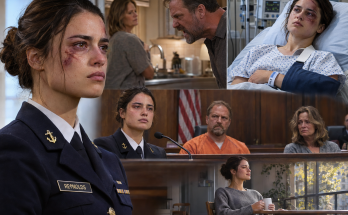
The final outcome came several weeks later.
By then, I had returned to a more regular routine.
My medical restrictions had gradually been reduced.
I was rebuilding my strength and becoming more comfortable with the responsibilities that had once filled my days.
There were still moments when memories interrupted ordinary activities.
But they no longer occupied every hour.
I had begun sleeping better.
I was eating properly.
I could concentrate on work without constantly wondering what Richard or my mother might be doing.
Then I received the update I had been waiting for.
Richard had been held legally responsible for the assault.
The case had reached its resolution.
There were consequences for his actions, including restrictions intended to protect me from further contact.
I listened carefully as everything was explained.
I asked questions about what those restrictions meant.
I wanted to understand what I should do if Richard attempted to contact me.
I wanted to know which documents I needed to keep.
Once I had the necessary information, I ended the conversation.
Then I sat quietly.
I had imagined that moment many times.
Sometimes I pictured myself crying with relief.
Sometimes I imagined feeling victorious.
In reality, I felt tired.
A deep kind of tiredness that seemed to come from somewhere beyond the preceding months.
It reminded me of how long I had been waiting for somebody else to acknowledge what Richard had done.
Not just during the attack in my apartment.
Throughout the years when I had been too young to protect myself.
The legal outcome couldn't return those years to me.
It couldn't change my mother's decisions.
It couldn't remove every memory associated with the old house.
But it established something important.
Richard's actions had consequences that I was not responsible for preventing.
I didn't need to explain them away.
I didn't need to protect him from them.
I didn't even need to understand how he felt about them.
For the first time, those responsibilities belonged entirely to him.
I stood and went into the kitchen.
I filled a glass with water.
Then I turned off the faucet.
I listened to the silence afterward.
Nothing frightening followed.
Nobody demanded an explanation.
Nobody told me I had done something wrong.
I drank the water and returned to the living room.
Later that afternoon, my mother called.
I considered whether I wanted to answer.
There was no obligation to do so.
That realization still felt unfamiliar.
Eventually, I picked up.
"Hello, Mom."
She sounded exhausted.
"I suppose you've heard."
"Yes."
A long silence followed.
Then she began talking about Richard.
She described how difficult everything had become.
She discussed the consequences he faced.
She spoke about uncertainty in her own life.
I listened.
I didn't interrupt.
But I noticed that she still hadn't asked how I felt.
When she finished, I waited.
Finally, she said something I had been expecting.
"I wish things had turned out differently."
"So do I."
She sounded surprised.
For years, she had treated my unwillingness to forgive Richard as evidence that I wanted him to suffer.
She hadn't understood that I would have preferred never to have been hurt in the first place.
I would have preferred a childhood in which I wasn't frightened of the man living in my house.
I would have preferred a mother who intervened.
I would have preferred an adulthood in which I never needed to send an emergency signal from my apartment.
I hadn't chosen any of those circumstances.
I had chosen what to do after they happened.
My mother spoke again.
"Do you hate him?"
I thought carefully before answering.
"No."
That was the truth.
I had been angry with Richard.
I had been frightened of him.
I had spent years resenting the influence he continued to have over my life.
But I didn't want hatred to become another way of remaining connected to him.
"I don't want him in my life."
My mother began crying.
I looked toward the apartment entrance.
There had been a time when her tears could persuade me to abandon almost any decision.
I still found them difficult to hear.
But I no longer considered them an instruction.
"Ava, he's been part of our family for so long."
"I know."
"How can you just walk away?"
I leaned back against the couch.
"I'm not doing it because it's easy."
She became quiet.
"I'm doing it because I need to be safe."
My mother didn't argue immediately.
That surprised me.
Eventually, she asked whether I intended to stop speaking to her too.
I had considered that question many times.
I didn't want to make a decision out of anger.
I also didn't want to maintain a relationship that required me to pretend Richard's behavior was acceptable.
"I need some distance."
"What does that mean?"
"It means I'm not going to discuss Richard with you anymore."
She sighed.
"And if you keep asking me to change my account of what happened, I'll end the conversation."
My mother didn't respond.
I waited.
Then she asked another question.
"Do you really believe I didn't protect you?"
My throat tightened.
There were so many ways I could have answered.
I could have softened it.
I could have told her that everyone made mistakes.
I could have reassured her that I understood how difficult her circumstances might have been.
Those would have been familiar responses.
Instead, I told her what I actually believed.
"You didn't."
The words were quiet.
She began speaking, then stopped.
I continued.
"I needed you when I was a child."
I felt tears coming.
This time, I didn't try to hide them.
"I shouldn't have had to convince you."
For a long while, neither of us spoke.
I wondered whether she remembered the kitchen as clearly as I did.
Whether she remembered my voice.
Whether she remembered the occasions when she had turned away because acknowledging what was happening would have required her to make a difficult decision.
I couldn't know.
Eventually, she spoke.
"I should have done more."
I closed my eyes.
It wasn't everything.
It wasn't the complete apology I had imagined throughout my life.
She hadn't explained her choices.
She hadn't fully acknowledged the years of harm.
But she had finally admitted that there had been something she should have done differently.
I allowed myself to hear it without pretending it was enough to repair everything.
"Yes, Mom. You should have."
She cried again.
So did I.
For once, I didn't feel compelled to comfort her before acknowledging my own pain.
We ended the conversation without making promises about the future.
I didn't know whether she would eventually accept the boundaries I had established.
I hoped she would.
But I wasn't prepared to make my safety dependent on that hope.
Afterward, I sat by the window.
I watched people moving outside.
For most of my life, I had believed that family relationships were something I needed to maintain regardless of their cost.
Now I understood that I could love somebody and still recognize that contact with them might be harmful.
I could remember good moments without denying the bad ones.
I could wish my mother well without returning to the role she expected me to occupy.
Those distinctions had taken me years to learn.
The following morning, I put on my uniform.
I stood before the mirror and adjusted it carefully.
My reflection looked familiar.
There was a time when wearing that uniform had represented my escape from Richard.
I had believed my rank would make me untouchable.
I had thought professional competence could protect me from everything I carried privately.
It couldn't.
But I no longer needed it to.
My uniform represented work I had earned.
It represented responsibilities I had accepted.
It represented a life I had built through effort and commitment.
It didn't require me to conceal the fact that I had been hurt.
I could be Lieutenant Ava Reynolds and still be a woman who needed help.
Both things could be true.
That morning, I encountered Chief Hayes.
He recognized me immediately.
"Good to see you back, Lieutenant."
"Good to be back."
He asked how my recovery was progressing.
I told him the truth.
My shoulder occasionally became uncomfortable.
I was continuing to follow medical guidance.
Otherwise, I was doing well.
He nodded.
"I'm glad to hear it."
I hesitated before speaking again.
"The case is finished."
His expression became serious.
"How are you feeling about that?"
I considered the question.
"Relieved, mostly."
He nodded.
"That's understandable."
I looked at him.
There was something I had wanted to say for a long time.
"Do you remember asking me my name that night?"
He smiled slightly.
"Of course."
"I remember how difficult it was to answer."
"You were hurt."
I nodded.
"You never made me feel embarrassed about needing help."
Chief Hayes didn't immediately respond.
Then he said something simple.
"Nobody should."
I carried those words with me.
There wasn't a grand ceremony marking the end of my recovery.
There was no single morning when every difficult memory disappeared.
Instead, life gradually became ordinary again.
I completed my work.
I attended follow-up appointments when necessary.
I spent evenings in my apartment.
I made meals.
I read.
I slept.
Sometimes I heard footsteps outside my door and felt the old fear return.
When that happened, I reminded myself where I was.
I reminded myself that I had choices.
I could check the entrance.
I could contact somebody if I needed assistance.
I didn't have to wait quietly for a frightening situation to become worse.
Over time, those reminders became less necessary.
One Saturday morning, I decided to replace the kitchen chair.
There was nothing structurally wrong with it.
I had kept it for months after the apartment was repaired.
At first, keeping it had been my way of refusing to let Richard decide what belonged in my home.
But I realized I didn't particularly like the chair anymore.
That was reason enough.
I chose a new one.
Nothing expensive.
Nothing remarkable.
Just a comfortable chair that fit beneath my kitchen table.
When I brought it home, I placed it where the old one had stood.
I sat down.
The apartment was quiet.
Sunlight fell across the floor.
For a moment, I thought about the night Richard had been removed.
The blood near the kitchen.
The damaged doorway.
The officers moving through the apartment.
Chief Hayes telling me to remain still.
I could remember all of it.
But those memories no longer defined everything I saw.
The kitchen was also where I made coffee.
The apartment entrance was also where I welcomed people I trusted.
The floor was also where sunlight appeared on clear mornings.
Richard had hurt me in that home.
He hadn't earned the right to own every memory I would make there afterward.
I finished my coffee.
Then I washed the cup.
As I stood at the sink, I remembered my mother again.
The old kitchen.
The running water.
Her back turned toward me.
For years, that memory had ended with a little girl waiting.
Waiting for somebody to look at her.
Waiting for somebody to ask what was wrong.
Waiting for permission to acknowledge that she had been hurt.
I turned off the water.
I stood quietly.
I wished I could reach backward through the years and tell that child what would eventually happen.
She would finish school.
She would build a career.
She would establish a home of her own.
She would become someone capable of making decisions that once seemed impossible.
And one night, when the man she feared tried to make her protect him again, she would ask for help.
People would come.
They would listen.
They would stand between her and the person hurting her.
Eventually, she would understand that she had never been responsible for managing his anger.
I couldn't change her childhood.
That remained one of the hardest truths to accept.
But I could honor what she had endured by refusing to live according to the rules that had kept her frightened.
My relationship with my mother remained distant.
We spoke occasionally.
When she respected my boundaries, I was willing to continue the conversation.
When she returned to old arguments, I ended it.
I no longer measured the success of our relationship by how much discomfort I could tolerate.
Richard remained outside my life.
I didn't seek information about his daily circumstances.
I didn't wait for an apology.
I didn't organize my future around the possibility that he might eventually understand the harm he had caused.
His decisions belonged to him.
Mine belonged to me.
Months after the attack, I found the hospital bracelet among the documents I had saved.
The printed letters had faded slightly.
AVA REYNOLDS.
I held it for a moment.
I remembered looking at it while lying in the hospital bed.
At the time, I had found comfort in something so simple.
My own name.
An identity that existed beyond Richard's expectations and my mother's approval.
I placed the bracelet back in the drawer.
I didn't need to keep it somewhere visible.
I didn't need a daily reminder of what I had survived.
I knew.
That evening, I prepared dinner and sat in my new kitchen chair.
My phone was beside me.
There were no urgent messages demanding that I explain myself.
No accusations.
No instructions about how I needed to behave.
Just an ordinary evening.
I had once believed that being strong meant enduring whatever happened without allowing anyone to see the damage.
I understood strength differently now.
Sometimes it meant saying that something hurt.
Sometimes it meant refusing an unreasonable demand.
Sometimes it meant reaching for help even when years of fear told me to remain silent.
And sometimes it meant closing a door.
Not because I was afraid of the world outside.
Because I had finally learned that I was allowed to decide who entered my life.
After dinner, I washed my dishes.
I turned off the kitchen light.
Then I walked to the apartment entrance and checked the lock.
The door was secure.
I stood there for a moment, remembering how it had looked when the officers came through it.
That damaged doorway had once represented the destruction of the safety I had worked so hard to create.
Now the repaired door represented something else.
A boundary.
A choice.
A life that belonged to me.
I went to bed without wondering whether Richard was angry.
I didn't rehearse explanations for my mother.
I didn't apologize to anyone for needing protection.
I had spent enough years waiting for other people to decide whether my pain mattered.
I wasn't waiting anymore.
My name was Ava Reynolds.
I was a daughter.
I was a naval officer.
I was a woman who had survived things she should never have been expected to endure.
But survival wasn't the only thing I wanted from life.
I wanted peace.
I wanted ordinary mornings.
I wanted relationships in which kindness didn't come with conditions.
I wanted to live without measuring every decision against somebody else's anger.
And finally, I understood that I could begin building that future without Richard's permission or my mother's approval.
The apartment was quiet when I closed my eyes.
For once, I wasn't listening for footsteps.
I was simply going to sleep.
I was home.
And I was free.
The End
Read more original stories on Feel Every Story.
I Had Learned to Stay Calm Under Pressure, but Nothing Prepared Me for the Man Kneeling Beside Me That Night
Part 10 of 10